

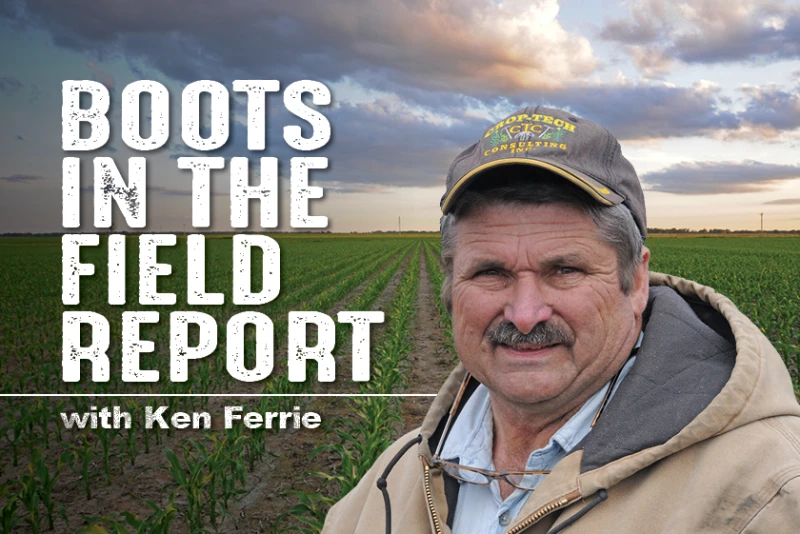
Soil conditions, temperatures and weather outlook are finally aligned this week in much of Illinois and other parts of the Midwest. “Let the big dogs run, and keep the planters running until you’re finished,” says Ken Ferrie.
In the process of planting, he offers corn growers this reminder: to get a 250-bushel corn yield average at harvest, you have to start with a 300-bushel picket-fence stand.
Here are seven recommendations Ferrie offers that can help you grow what could be the biggest corn crop of your career:
1. Plant early-maturing corn hybrids first and end with your full-season hybrids.
This will mitigate the risk of having all your corn pollinating at the same time, says Ferrie, Farm Journal Field Agronomist.
“If you do it the other way around, all your corn is going to pollinate in the same week, and then it’s all going to be ready to harvest at the same time, which puts a time crunch into your harvest,” he explains. “So, let’s stretch out the risk by mitigating it, planting our shorter season hybrids first, our full-season hybrids last.”
Going with that approach will also make it easier on the rest of your farming crew when it comes to scouting, spraying and harvesting the crop this season.
2. Consider your planter closing system.
Ferrie explains that your planter closing system has two things it needs to accomplish: It needs to close the furrow from the bottom up, and it needs to firm the soil over the top of that seed so that moisture doesn’t get away.
Ferrie says spike wheels struggle with the firming part in dry conditions – if that describes your situation.
“In dry conditions, go back to the solid wheels if you still have them, especially in tilled fields,” he advises. “Make sure the depth wheels stay snug against the disk opener and don’t allow dry surface soil to fall into that trench and get onto the seed before we close it.”
In tilled soils, Ferrie says you may have to increase your downforce on your depth wheels to hold a true V, which can help prevent surface soil from falling in on the seed.
“We need to be at 100% contact but we’ve got to make sure that we’re not sloughing dry soil into the trench,” he says. “You may have to go up on your margin – up on your down pressure.”
3. Do cross-sections of the furrow to see if you have sidewall smearing.
Sidewall smearing results from too much downforce, in conditions that are too wet or in soils that are a combination of wet and dry.
If the monitor tells you to lighten the downforce, lighten it until the monitor tells you you’re not maintaining the needed planting depth. Then, add downforce until you reach what the monitor says the correct depth is being maintained.
At this point, get off the tractor and do your cross-sections of the furrow, checking for any sidewall smearing.
“We don’t want to see a scene in the furrow where both sides come together. We want that furrow closing without any evidence of how that seed got there,” Ferrie says.
“If you can’t get rid of sidewall smearing without losing adequate depth, it’s too wet to plant,” Ferrie says. “Don’t only check the dry parts of the field, of course, check the wetter ones as well.”
4. Evaluate the performance of row cleaners. If you’re faced with a planting scenario where there’s dry soil on top of the field and too much moisture present at the planting depth, take care with how much of the residue you remove. Push it aside only enough that your disc openers can flow through the soil.
“Don’t plow all the dry real estate off the top with your row cleaners and then set your depth wheels in the wet soil,” Ferrie advises. “Run on top of that dry soil and plant into the soil moisture.”
5. Trust but verify what the monitors tell you. Technology can help you but don’t rely on it. You have to get off the tractor and check soils and your planting quality.
“Check a couple of times in every field to verify what the monitor tells you,” Ferrie advises.
He offers more corn planting tips during his Wednesday AgriTalk discussion with Host Chip Flory.
6. Keep a seed sample from each hybrid, if you didn’t do any seed testing ahead of planting.
Keep samples in a cool, dry place until the crop comes up. “If you get good emergence, discard the sample. If you end up with poor emergence, send the sample off to check the quality of it. This will allow you to identify if seed quality had anything to do with your poor stand,” he says.
7. Do a good job of labeling each hybrid in the monitor. Make sure you put in the correct information prior to starting every field.
“The better job you do, the easier it’ll be for everyone that comes behind you, from your sprayer operators to bug scouts, to combine operators all the way to the yield map meetings in the fall,” Ferrie says. “Everyone else will appreciate it, plus it beats writing the information down in a pocket notebook that many times ends up going through the washing machine.”
That doesn’t mean you can’t have a written copy of what you planted, but digital records can be shared so much faster and easier than what you jotted down in a notebook, he adds.
Check out this week’s Boots In The Field podcast if you’re planting soybeans this week, for more great agronomic tips:
Your next read: Rain Slows Record Start to Iowa Planting Season, but Farmers Optimistic About Early Finish



